
PAIA Compliance in South Africa: Is Your Business Ready for the 30 June Deadline?
 Every business in South Africa now carries obligations under the Promotion of Access to Information Act, commonly known as PAIA. Previously, many smaller businesses were exempt from certain PAIA submission requirements. Those exemptions have fallen away, and the Information Regulator has called for public and private bodies to submit PAIA annual reports for the 2025/26 period by 30 June 2026.
For many small and medium-sized businesses, the annual PAIA report may be a nil or low-activity submission. However, the compliance requirement still needs to be addressed properly, particularly where the business also has POPIA-related data protection obligations.
Accounting 4 Associates is ready to assist clients with the preparation of PAIA manuals, Information Officer registration checks or guidance, and annual PAIA report submissions to the Information Regulator.
What is PAIA?
PAIA is the Promotion of Access to Information Act. It gives effect to the constitutional right of access to information and applies to public bodies and private bodies. In the business context, private bodies include companies, close corporations, partnerships, sole proprietors, trusts, non-profit entities and other organisations that hold records in the course of their activities.
In practical terms, PAIA requires businesses to be clear about the records they hold, how members of the public may request access to those records, and who within the organisation is responsible for dealing with formal access-to-information requests.
What is a PAIA submission?
A PAIA submission is not a tax return or a financial statement. It is a compliance report submitted to the Information Regulator, dealing with access-to-information requests received and processed during the relevant reporting period.
The related PAIA manual is a public-facing document that explains the categories of records held by the business, how access requests may be made, and how personal information is processed in terms of POPIA.
Who needs to comply?
PAIA applies widely. Businesses should not assume that they are exempt simply because they are small, owner-managed or privately held. Companies, close corporations, sole proprietors, partnerships, trusts and non-profit entities may all have PAIA obligations if they hold records in the course of their activities.
The level of complexity may differ from one business to another, but the basic compliance principles remain the same: identify the responsible person, have an appropriate PAIA manual in place, and submit the annual report where required.
What does PAIA compliance include?
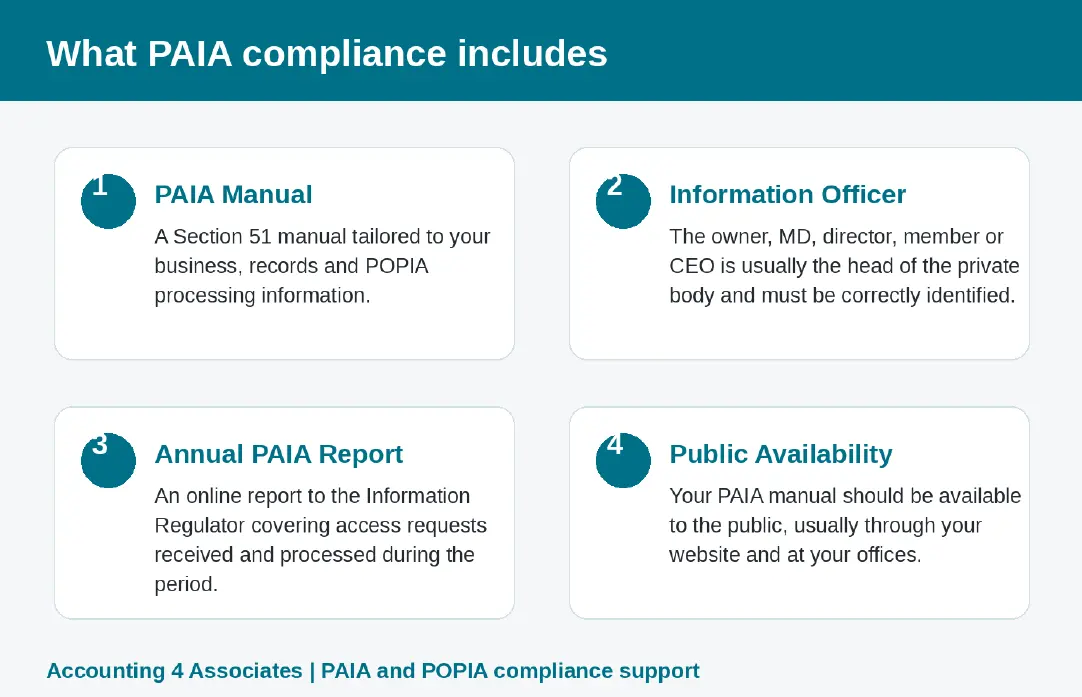
A practical PAIA compliance process usually includes the following three core components:
- A Section 51 PAIA manual: this sets out the business contact details, categories of records held, request procedures, and POPIA-related personal information processing details.
- An Information Officer or Head of Private Body: this is usually the owner, managing director, director, member, chief executive officer or other head of the business.
- An annual PAIA report: this is submitted through the Information Regulator’s portal and records the number and outcome of access requests received and processed during the reporting period.
The PAIA manual should also be made available to the public, usually on the business website and at the business premises.
 Why PAIA compliance matters now
The annual reporting deadline is 30 June each year. For the 2025/26 reporting period, the Information Regulator’s eServices portal records the submission period as 1 April 2026 to 30 June 2026.
The Regulator has also indicated that bodies will not be able to submit their annual reports unless the relevant Information Officer, Head of Private Body or Deputy Information Officer is registered with the Regulator.
This means that businesses should not leave the process until the last minute. If the Information Officer details are incomplete or incorrect, this may delay the annual submission process.
The hidden risk of non-compliance
Non-compliance can expose a business to regulatory enforcement, possible penalties and reputational damage. The risk is not only theoretical. PAIA and POPIA are closely linked in practice, because both deal with the way a business manages information.
A weak PAIA position may surface at exactly the wrong time, such as during a tender, due diligence process, funding application, audit, client onboarding review or supplier compliance check.
How Accounting 4 Associates can assist
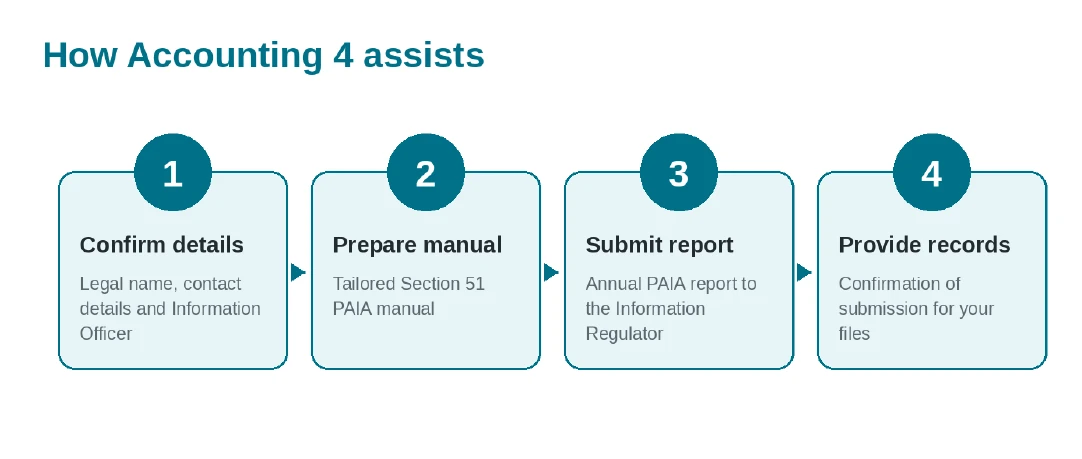
With the 30 June deadline approaching, PAIA compliance should be addressed without delay. Accounting 4 Associates is ready to assist with the preparation of your PAIA manual and the submission of your annual PAIA report to the Information Regulator.
Our service includes:
- tailoring your Section 51 PAIA manual to your business;
- checking or guiding the registration of your Information Officer;
- preparing and submitting the annual PAIA report;
- confirming whether formal PAIA requests were received during the reporting period; and
- providing confirmation of submission for your records.
 Arrange your PAIA submission
To arrange your submission, contact Accounting 4 Associates on 031 701 9722 or team@accounting4.co.za.
This article is provided for general information only and does not constitute legal advice. PAIA annual reports are submitted to the Information Regulator South Africa. More complex businesses may require a wider PAIA or POPIA compliance review.
FAQS
What is PAIA in South Africa?
PAIA is the Promotion of Access to Information Act. It gives effect to the constitutional right of access to information and requires public and private bodies to deal properly with formal requests for access to records.
Does my small business need a PAIA manual?
Many private bodies, including companies, close corporations, partnerships, sole proprietors, trusts and non-profits, may need a PAIA manual if they hold records in the course of their activities. The manual should explain what records are held and how access requests can be made.
Who is the Information Officer for a company?
For a private body, the head of the business is usually the responsible person. This may be the owner, managing director, director, member, chief executive officer or equivalent head of the organisation.
When is the PAIA annual report due?
The annual PAIA reporting deadline is 30 June each year. The 2025/26 period covers 1 April 2025 to 31 March 2026, with the submission window closing on 30 June 2026.
Is a PAIA submission the same as a tax return?
No. A PAIA annual report is not a tax return or a financial statement. It is a compliance report dealing with access-to-information requests received and processed by the organisation.
Can Accounting 4 assist with PAIA compliance?
Yes. Accounting 4 Associates can assist with tailoring the PAIA manual, checking or guiding Information Officer registration, preparing the annual PAIA report and providing confirmation of submission.
